
Your High School Has a Resume Too — Here's What's on It


Did you know that when you apply to college, the counseling center at your high school submits a school profile as part of your application? In a previous post, I explained that during holistic review, colleges look at the rigor of classes you took, as well as the context of your high school experience. The question is: how does the admissions committee know the context of your high school? This information comes from the school profile submitted by your high school counselor.
The profile includes everything from the number of AP classes offered to the number of students in your graduating class. It's often the only way for a college to learn about your specific educational environment. While admissions counselors at colleges often visit high schools during the fall, visiting and understanding the unique context of every high school in their region is impossible. With students applying from so many different contexts and high schools, the school profile becomes a bit of a cheat sheet to understand the context of a student's high school experience.
The problem...most students don't even know a school profile exists, much less that it is submitted as part of their application.
What is included on a school profile?
While it is up to each individual high school counseling center to put together the school profile, there is a common set of information that you can find on most school profiles. Here are two examples of school profiles—one from a local (to me) public high school and one from a private school just a few miles from the public school. Clearly the two school profiles differ visually, but they convey pretty much the same information.

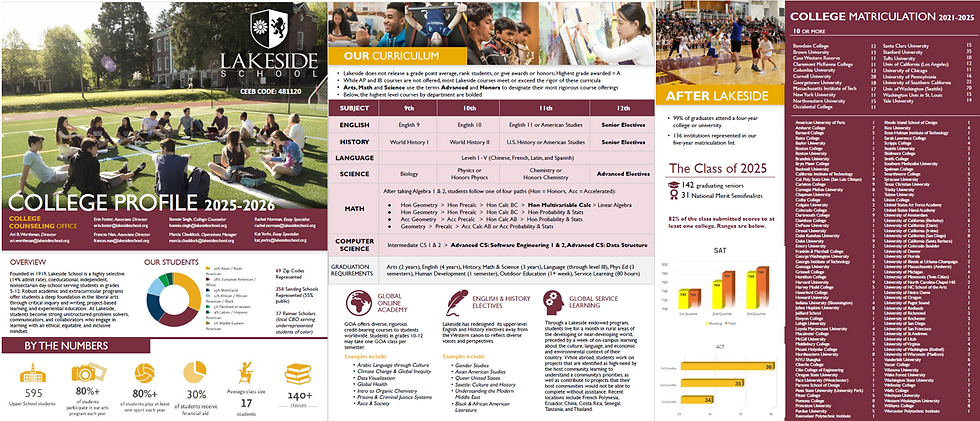
Demographic Context
Information often included:
Population — size of the graduating class, school, and school district (if applicable)
Racial breakdown
Percentage of students who receive free and reduced lunch
This information helps the admissions committee understand the economic and racial diversity of the school and the surrounding community. It also gives clues as to how well-funded and resourced the school is, which point to the availability of academic offerings, extracurricular activities, and resources for college preparation.
Academic Context
Information often included:
Grading Scale - including whether the GPA is weighted or unweighted
Curriculum - including advanced class offerings (honors, CHS (college in the high school), AP or IB classes)
Graduation Requirements
Extracurricular Opportunities
This information is helpful for determining the curricular rigor chosen by a student's. For example, if two students each take three AP classes, but one attends a school that only offers three AP classes while the other student attends a school that offers dozens of AP classes, the committee's perception of the intentional challenge sought by each student will differ. Likewise, the information in the profile indicates whether a student simply met or exceeded the graduation requirements.
Student Outcomes
Information often included:
Average ACT/SAT Scores
Graduation Rates
Post-Secondary Data — where students go after graduating
Notable awards (e.g. National Merit Semifinalists)
Colleges attended by recent graduates
This information helps contextualize a student's success within their community of peers. How does a student compare to those around them? Particularly given the correlation between high SAT scores and wealth, knowing the average SAT/ACT score within a high school contextualizes how a student performed compared to those in the same environment. Further, much of this information can show the challenges and obstacles a student faced during their educational journey.
So What Does This Mean for You?
Student's don't have the option to decide whether to submit their school's profile. That's why I think it is important to know what information is on the report. Being aware early in high school of the average student profile at your school and the opportunities available to you, can help you make informed academic choices. While you can't change the information, you can use it to your advantage to understand how you are situated among your peers. If you are above average, great. If you aren't, it might be helpful to include a note on your application about your unique situation. Either way, it's important to know what is being submitted on your behalf and how it could impact an admissions committee's perception of your application.
Not sure what's in your high school's profile? You can often find it on your high school's counseling website or through a Google search. If you haven't already, go find it now and know what your school says about you.


